

Cataracts and night driving often become connected when headlights suddenly seem harsher, road markings look dimmer, or familiar routes feel less comfortable after sunset. In Yuma, drivers may notice these changes while navigating poorly lit roads, bright oncoming traffic, or long stretches between destinations.
Cataracts can cause blurry or dim vision, glare, halos, and streaks around headlights and streetlights. The American Academy of Ophthalmology recommends limiting night driving when glare, halos, or reduced night vision begin affecting safety.
Why Cataracts Make Night Driving More Difficult
A cataract develops when the eye’s normally clear natural lens becomes cloudy. Instead of passing cleanly through the lens, light scatters as it enters the eye.

Drivers with cataracts may experience:
- Halos around headlights and streetlights
- Starbursts or streaks extending from bright lights
- Difficulty seeing lane markings or road signs
- Dim, cloudy, or yellowed vision
- Reduced contrast between objects and the background
- Increased sensitivity to oncoming headlights
- Trouble judging distance in poorly lit areas
- Greater discomfort when driving at dusk or in the rain
These changes often develop gradually. A driver may first avoid unfamiliar roads, then begin limiting nighttime trips without realizing that cataracts are contributing to the problem.
Aiello Eye Institute’s guide to the early signs of cataracts explains how cloudy vision, glare, fading colors, and difficulty seeing at night may appear as the lens becomes less clear.
Are Cataracts the Only Cause of Night Driving Problems?
No. Cataracts are common, but several other eye and vision concerns can make night driving harder.

Glaucoma can affect peripheral vision, while retinal or macular conditions may reduce central detail, contrast, or the ability to recognize hazards. Cataracts, glaucoma, retinal disease, refractive errors, and other eye conditions can interfere with the clarity of driving vision.
A comprehensive eye exam at Aiello Eye Institute can help determine whether the problem is due to cataracts, a change in prescription, dry eye, glaucoma, retinal disease, or more than one condition.
Signs It May Be Time to Stop Driving at Night
Night driving difficulties deserve attention when they begin changing your habits or confidence.
Consider limiting nighttime driving until you receive an eye examination if:
- You cannot recover quickly after bright headlights pass.
- Lane markings disappear in glare.
- You miss signs, curbs, pedestrians, or nearby vehicles.
- You need to follow another car closely to stay oriented.
- You frequently feel startled by objects that appear late.
- Family members have expressed concern.
- You avoid necessary trips because night driving feels unsafe.
Do not wait for a failed vision test or a near-collision before discussing these changes with an eye doctor.
Can Glasses Improve Night Driving with Cataracts?
A new prescription may improve night driving when refractive error contributes to blur. Anti-reflective lens coatings may also reduce reflections from the front and back surfaces of prescription lenses.
However, glasses cannot remove cloudiness from inside the natural lens. As a cataract progresses, prescription changes may provide less improvement.
Be cautious with heavily tinted or yellow “night driving” glasses. Any tint reduces the amount of light reaching the eye, which may make already-dark conditions harder to see. There is not a single special lens that has been proven to eliminate glare and halos for every night driver.
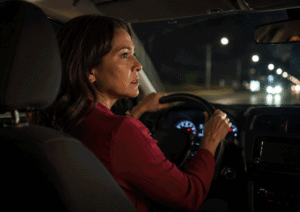

How Cataract Surgery May Change Night Driving Vision
During cataract surgery at Aiello Eye Institute, the surgeon removes the cloudy natural lens and replaces it with a clear intraocular lens, or IOL.
Removing the cataract may improve visual clarity, brightness, color perception, and contrast when the cataract causes those problems. Many patients also notice that glare from headlights becomes easier to manage after healing.
Results depend on the health of the cornea, retina, optic nerve, remaining prescription, and the replacement lens selected. Cataract surgery cannot restore vision lost from an unrelated eye disease.
Choosing a Cataract Lens with Night Driving in Mind
Your driving habits should be part of the cataract lens discussion before surgery.
A monofocal IOL usually provides a single focal length, typically for distance vision. Some patients still use glasses for the sharpest driving vision or to correct remaining astigmatism.
Toric IOLs can help correct certain types of corneal astigmatism. Multifocal and extended-depth-of-focus lenses may reduce dependence on glasses across a wider range of distances, but some patients notice halos, glare, or starbursts, particularly at night. Patients who prioritize night driving should discuss these visual effects with their ophthalmologist before choosing an IOL.
Review Aiello Eye Institute’s advanced cataract lens options and whether glasses may still be needed after cataract surgery before your consultation.
The best lens is not automatically the one with the most features. It is the one that fits your eye health, work, hobbies, driving needs, expectations, and budget.
When Can You Drive at Night After Cataract Surgery?

Vision may fluctuate during early healing. Temporary glare, halos, light sensitivity, or blurred vision may occur, and the two eyes may feel unbalanced if surgery is completed on different days.
Return to night driving only after your surgeon has cleared you, and you feel able to recognize signs, lane markings, pedestrians, and hazards comfortably. Aiello Eye Institute’s cataract surgery recovery guide offers more information about healing and follow-up care.
Persistent or worsening glare, halos, pain, redness, or declining vision should be reported to your eye doctor rather than treated as a normal adjustment.
See the Road More Clearly in Yuma
Difficulty driving at night is not something you have to dismiss as an unavoidable part of aging. A comprehensive eye exam can determine whether cataracts, dry eye, glaucoma, retinal changes, or an outdated prescription are affecting your vision.
If headlights, glare, dim roads, or reduced confidence have changed the way you drive, request an appointment with Aiello Eye Institute or call 928-782-1980. If it has been a while since your last eye exam, schedule one today.